Thank you for stopping by! I am a highly experienced, Texas-based copywriter with approximately 15 years of experience writing in education, real estate, mortgages and finance, healthcare and personal injury. I also have several ghostwritten articles published on Inman News under the name John Majalca. These are links to 2019 and 2020 samples of my copywriting:
This is a February 2019 article that went viral around the world. It is from the site Weedkillercrisis.com. My editor does not want a direct link to it, so I produced the article in full below.
New Report Shows Roundup Weedkiller Exposure, Massive Health Problems in Americans
Monsanto’s weedkiller Roundup has been one of the most popular pesticides around the world since the 1970s; in fact, it is the most widely used pesticide ever. Roundup is used heavily in agriculture for many of the most popular crops, and also is used by millions of consumers on their gardens at home.
However, its key ingredient – glyphosate – has been at the center of a firestorm of controversy that is getting more intense by the year. More crops are genetically modified to be tolerant of glyphosate, leading to higher yields for giant agriculture companies. But the chemical has been found to cause a variety of serious health problems, including the deadly cancer Non-Hodgkin’s lymphoma.
The EPA classified glyphosate a potential carcinogen in 1985, but the agency later reversed its decision.
Roundup-Ready soybeans hit the agricultural market in 1996, followed by Roundup Ready corn in 1998.
Rates of glyphosate observed in humans then skyrockets by 500% in a period between 1993 and 2016.
93% of Americans were found to have glyphosate residues in their urine.
The USDA released a study that found 99% of the food samples tested to have some level of pesticide residue.
250 million pounds are sprayed on our crops, lawns, and parks each year in the U.S., with 1.65 billion pounds used each year around the world.
Glyphosate in the body prevents red blood cells from maintaining healthy levels of vitamin C, which is important not only for immunity but also for blood vessel and heart health.
“Glyphosate formulations decreased human cell “viability”, disrupting cell membranes. Cell viability was “significantly altered” by the formulations”, says National Toxicology Program.
World Health Organization’s (WHO) International Agency for Research on Cancer (IARC) concluded in 2015 that glyphosate is a “probable carcinogen” in humans.
The term ‘probable human carcinogen’ means it may cause cancer (Cancer.org)
6 IN 10 Adults in the US have a chronic disease; 4 IN 10 Adults have two or more. (CDC.gov)
Second U.S. Jury Says Monsanto’s Roundup Weedkiller Caused Man’s (Non-Hodgkins Lymphoma) Cancer (Wallstreet Journal)
In an ironic twist, glyphosate has been shown to be toxic to the liver in basic, phase one detoxification processes involving the cytochrome pathways. It is alarming that one of the most toxic chemicals in the world can actually impair human detoxification processes. So, the toxic chemical glyphosate actually makes it more difficult to detox.
Before we explore the myriad of diseases and illness on the rise, let’s look at where and how it’s used.
Glyphosate Use Across the United States
Sourced directly from the United States Geological Survey, this graphic shows the estimated annual agricultural pesticide use for glyphosate for the latest reported year of 2016.
Glyphosate Use by Crop Type
The total amount of glyphosate applied to corn, soybeans, wheat, cotton, vegetables and fruit, rice, orchards and grapes, alfalfa, pasture and hay and other crops. Use amounts are measured in millions of pounds. (Source ResearchGate.net)
Health Problems Correlated with Glyphosate Use
Allergies and autoimmune illnesses are becoming so common today that it is easy to forget they could be signals of immunity failure. They may affect the ability of our bodies to optimize health. The higher number of allergies being seen in the human population could be an indicator that harmful substances are invading our bodies. People who suffer from allergies, autoimmune diseases, diabetes and other serious illnesses could be a ‘canary in the coal mine’ for the rest of us.
Let’s take a look at the most recently studied health problems correlated with glyphosate usage around the country.
The following associated charts are courtesy of Researchgate.net, a professional network for scientists and researchers.
In This Section
Alzheimer’s Disease
Autism Disorder
Attention Deficit
Anxiety Disorder
Breast Cancer
Celiac Disease
Crohn’s/Ulcerative Colitis
Dementia
Diabetes
Liver Disease
Obesity
Renal/Kidney Disease
Thyroid Cancer
Alzheimer’s Disease
Alzheimer’s disease is the most common type of dementia. Over time, people who develop this disease lose most of their memory, cannot concentrate, and can no longer perform the common daily functions of living.
ALz.org reports that Alzheimer’s disease is the #6 leading cause of death in the US. More than 16 million people in the United States provide free car for people suffering from this type of dementia.
An estimated 5.7 million Americans have some degree of Alzheimer’s dementia as of 2018. This includes at least 5.5 million people who are 65 or older, and 200,000 people under 65.
The following chart shows the correlation between deaths due to Alzheimer’s disease and glyphosate applications to corn and soy crops. Data discontinuity between 1998 and 1999 has been removed by subtracting a constant from 1999-2010 data points. Discontinuity arises in some data because of the ICD code change from the ninth revision to the tenth (ICD-9, ICD-10). (Source ResearchGate.net)
Autism Disorder
Autism spectrum disorder or ASD is a type of neurodevelopmental disorder that features deficits in social communication and social interaction. It also presents restricted and repetitive behaviors that make it difficult for the person to interact normally with other people.
CDC reports that one in 59 children have autism spectrum disorder, and this disease is reported to occur in all racial, ethnic and socioeconomic groups.
ASD is four times more common in boys than girls, and studies in Asia, Europe and North America show that approximately 1-2% of the population develops the disorder.
According to Stephanie Seneff, a Senior Research Scientist at the MIT Computer Science and Artificial Intelligence Laboratory, said, “At today’s rate, by 2025, one in two children will be autistic.”
The following chart shows the correlation between autism prevalence, from hospital discharge data, and glyphosate applications to corn and soy crops. (Source ResearchGate.net)
ADHD
Attention-deficit/hyperactivity disorder or ADHD is a disorder of the brain that is marked by a regular pattern of inattention and often hyperactivity and impulsivity that can interfere with a child’s development and overall cognitive function.
According to the CDC, it is estimated as of 2013 that 5% of children in the US have ADHD. But other studies in the US have determined the rates could be higher.
CDC also notes that the number of children from 4-17 that were ever diagnosed with ADHD increased from 7.8% in 2003 to 9.5% in 2007 to 11% in 2011 and 12.
Approximately two out of three children with ADHD have at least one other emotional, mental or behavioral disorder.
The following chart shows the correlation between ADHD prevalence and glyphosate applications to corn and soy crops. (Source ResearchGate.net)
Anxiety Disorder
Anxiety is a feeling of worry, nervousness or unease that all humans feel from time to time. But anxiety disorder is a serious medical condition that can cause people to have serious physical and psychological symptoms, including sweating, rapid heartbeat, dizziness, nausea and shortness of breath.
People who suffer from anxiety disorder are at least 3X more likely to go to a doctor and six times more likely to be hospitalized for a mental health disorder.
The following chart shows the correlation between anxiety prevalence and glyphosate applications to corn and soy crops. (Source ResearchGate.net)
Breast Cancer
Breast cancer means malignant tumors are forming in the tissue of one or both breasts. Some of the common symptoms of breast cancer is a breast lump, change in the size and shape of the breast, nipple drainage, skin dimples in the breast and red patches on the breast(s).
Breastcancer.org states one in eight women will develop some form of breast cancer in their lives.
In 2018, it was estimated there would be 266,100 new cases of invasive breast cancer in the US. There also will be 64,000 cases of non-invasive breast cancer.
Breast cancer rates have been decreasing since the year 2000, after going up the previous two decades. Rates declined by 7% from 2002 to 2003 alone. One theory is that the decrease was somewhat due to the lower use of hormone replacement therapy (HRT).
The following chart shows the Incidence of breast cancer in US hospital discharge data from 1998 to 2010 normalized to counts per 1,000,000 population each year, after subtraction of an exponential model accounting for the decline in the years up to 2006 in the Caucasian subpopulation [see text]. This includes all reports of ICD-9 codes 174 and 175. The red line shows trends in glyphosate usage on corn and soy crops over the same time period. (Source ResearchGate.net)
Celiac Disease
Celiac disease is an autoimmune disorder that can happen to people who are genetically more likely to get the condition. It occurs when ingesting gluten damages the small intestine. It is thought to affect millions of people around the world. When people with this disease eat gluten, the body attacks the small intestine in a strong immune response. Such attacks damage the villi, or tiny, fingerlike projections that line the organ.
According to a study done by University of Maryland, Division of Pediatric Gastroenterology and Nutrition, Celiac disease is associated with increased risk to non Hodgkin’s lymphoma
On average in the US, 1 in 133 people have celiac disease.
Celiac disease affects at least three million Americans.
The following chart shows the correlation between increase in celiac disease (gluten intolerance) and increase in use of the herbicide glyphosate (Roundup ® ) on genetically modified grain (Samsel &Seneff, 2013). (Source ResearchGate.net)
Crohn’s/Ulcerative Colitis
Ulcerative colitis is a chronic disease that causes serious inflammation, including irritation, swelling, and sores on the inside lining of the small intestine. Ulcerative colitis usually begins slowly and can get worse over months and years. Symptoms can vary from mild to severe. Many people have long periods of remission that can last for weeks, months, or years.
More people in the Northeast and Midwest get ulcerative colitis than in other parts of the country.
It is estimated that the total yearly cost of ulcerative colitis is $2.7 billion per year in the US.
The following chart shows the Correlation between inflammatory bowel disease and glyphosate applications to US corn and soy crops. (Source ResearchGate.net)
Dementia
Dementia is a general name for any disorder or disease that causes a major change in memory or cognitive abilities. Dementia is severe enough to damage the person’s daily ability to function, such as drive, shop, eat, dress, work and communicate. The most common type of dementia is Alzheimer’s disease, but there are other forms, such as Parkinson’s Disease dementia, Huntington’s disease and family prion disease.
If global dementia were a nation, it would be the 18th biggest economy in the world.
The following chart shows the correlation between dementia prevalence and glyphosate applications to corn and soy crops. (Source ResearchGate.net)
Diabetes
Diabetes is a metabolism disorder. Metabolism refers to the way the body digests food for energy and growth. Most foods we eat are broken down into a basic form of sugar called glucose; this is the major fuel source of the body. Insulin is produced by the pancreas to transfer glucose from blood to the cells. With diabetes, cells fail to respond properly to insulin produced by the body.
Webmd.com finds that 23.6 million people in the US – almost 8% of the population – have diabetes.
Each year, approximately 1.5 million people in the US 20+ years of age are diagnosed with the disorder.
The following chart shows the correlation between age-adjusted diabetes prevalence and glyphosate applications and percentage of US corn and soy crops that are GE. (Source ResearchGate.net)
Liver Disease
Fatty liver disease is also called non-alcoholic steatohepatitis, known as NASH. With the rise of the obesity epidemic, it causes scarring and inflammation leading to cirrhosis, cardiac and lung complications, cancer and death.
The U.S. is spending $5 billion annually in health-care costs related to the disease, which include chemotherapy, transplants, tests and hospitalizations, reports the Center for Disease Analysis.
The National Institutes of Health estimates as many as 12 percent of U.S. adults have this disease, or 30 million people and growing.
The following chart shows the correlation between age-adjusted liver cancer incidence and glyphosate applications and percentage of US corn and soy crops that are GE. (Source ResearchGate.net)
Obesity
Obesity is one of the most preventable and leading causes of death in the United States. Obesity is a serious chronic disease that can seriously damage health, including heart disease, diabetes, joint problems and more.
The CDC reports obesity affected 93 million adults in 2015 and 2016.
The estimated cost of obesity in the US was $147 billion in 2008.
The medical costs for people with obesity is on average $1429 higher than people who have a normal weight.
Prevalence of obesity in the US was 35.7% among young adults from 20-39, and 42% among those from 40-59.
The following chart shows the correlation between age-adjusted obesity deaths and glyphosate applications and percentage of US corn and soy crops that are GE. (Source ResearchGate.net)
Renal/Kidney Disease
Kidney failure is also called end-stage renal disease or ESRD. It is the final stage of chronic kidney disease, and it is generally caused by many other serious health problems that have damaged the kidneys over the years. Early stages of kidney disease may not even be noticed by the person.
Kidney disease affects 30 million people in the United States, and 90% of those with the disease are unaware they have it.
Currently, kidney disease is the #9 leading cause of death in the United States and is becoming more common.
The following chart shows the correlation between age-adjusted kidney cancer incidence and glyphosate applications and percentage of US corn and soy crops that are GE. (Source ResearchGate.net)
Thyroid Cancer
Thyroid cancer develops in the thyroid gland. This gland has a butterfly shape in the front of the neck, under the Adam’s apple. It wraps around the front of the windpipe. This gland is part of the endocrine system and produces and controls important hormones.
Cancer.net reports that 53,990 adults in the US will be diagnosed with thyroid cancer. Thyroid cancer is the #5 most common cause of cancer in women.
The incidence rates of this type of cancer in men and women grew at a 4% rate a year between 2005 and 2014. It also is the most rapidly increasing type of cancer diagnosis in the US.
Estimates by Cancer.net says 2060 deaths from thyroid cancer this year. Women are three times more likely to get the disease than men.
The following chart shows the plots of glyphosate usage on corn and soy crops (blue), percent of corn and soy that is genetically engineered to be “Roundup Ready” (red), and incidence of thyroid cancer (yellow bars) in the US. (Figure courtesy of Dr. Nancy Swanson) (Source ResearchGate.net)
Conclusion
Scientific evidence is rapidly growing that indicates glyphosate in the Roundup formulation leads to many serious health problems. Giving that this toxic chemical can cause diseases from cancer to dementia to autism, isn’t it time for more to be done to eliminate the use of glyphosate in agriculture? Where are the alternatives? Why hasn’t the EPA re-classified it as a human carcinogen?
As of this writing, at least 13 countries, including Germany and Belgium, have introduced legislation to limit or ban the use of glyphosate. More countries are considering it. However, in the US, the EPA continues to give the green light to glyphosate and Roundup use. Perhaps as more scientific evidence is revealed about the dangers of this chemical, the tide will turn against Monsanto and Roundup even in the United States, but in the meantime, we’ll have to wait and see.
Monstanto Slammed With $80 Million Verdict in First Federal Roundup Trial
A California jury found unanimously today that Monsanto is liable for failing to provide adequate warnings that its bestselling Roundup weedkiller could cause non-Hodgkins lymphoma (NHA) and other cancers. The federal jury awarded a California man more than $80 million, and delivered a devastating blow to Monsanto and its parent company Bayer AG, in the first bellwether trial. (Law360.com)
After only a day of deliberations, the jury of five women and one man
determined that Monsanto was liable for a negligence claim, a design
defect claim and a failure to warn claim. The jury decided to award Ed
Hardeman, 70, $200,967 in economic damages, $5 million in future and
past noneconomic damages, and a stunning $75 million in punitive
damages. (Ewg.org)
Verdict Marks Conclusion of 30 Day, 2-Part Trial
The huge verdict in favor of the plaintiff Hardeman marks the end of a
month-long, two-part federal trial over allegations that decades of
Hardeman using Roundup on his Santa Rosa, California property led to his
NHA. The first part of the weedkiller trial concluded March 19. The
jury decided Roundup was a major factor in causing his cancer. This sent
the case into the second phase to determine what the liability and
damages would be.
During part two, the jury listened to evidence that from 1980 to
2012, Monsanto had knowledge of five epidemiological studies, seven
studies involving animals, three oxidative stress studies and 14
genotoxicity clinical studies that showed a connection between Roundup
and cancer. Hardeman’s attorney, Jennifer Ann Moore, stated during
closing arguments that despite the overwhelming clinical evidence,
Monsanto never provided any warnings to consumers. The company also
declined to do its own long term research on the cancer dangers of
Roundup.
Monsanto ‘Manipulated the Science’ – Plaintiff’s Attorney
Moore also made accusations against Monsanto executives, saying that
they ghost-wrote several white papers in the 1990s and 2000s to
allegedly mislead federal officials and regulators and consumers about
the safety of Roundup. She requested the jury award punitive damages
against the company for ‘manipulating the science’ and the opinion of
the public for years. She pointed out that Bayer purchased Monsanto for
$63 billion in June 2018, and that the company made a profit of $210
million from sales of Roundup in only one year.
Glyphosate Never Found to Cause Cancer Before – Defense Counsel
Defense counsel also stated that to hand out punitive damages, the
jury must believe that Monsanto’s executives and other employees
committed crimes and lied about the safety of the product. But, Stekloff
argued, Monsanto’s employees backed the safety profile of Roundup. They
all testified that they use the popular weedkiller at home and do not
use any protection.
Stekloff also said that even if Monsanto needed to provide a warning
to consumers about risks of cancer, there is no convincing evidence that
Hardeman even would have read the label.
But on this day, the jury took the side of the plaintiff and laid a crushing blow on Monsanto.
In response, Bayer has said that it will appeal the verdict. Their
press statement noted that Bayer still stands behind Roundup and will
continue to mount a strong defense.
Hardeman Case First to Go to Trial
The Santa Rosa man’s roundup cancer lawsuit
was the first Roundup case to go to the trial phase, out of hundreds of
related lawsuits that still are pending in the Northern District of
California over allegations of cancer involving Roundup and Ranger Pro.
As of January 2019, almost 700 Roundup product liability cases were
consolidated in the court of US District Judge Vince Chhabria.
The next case regarding Roundup that will go to trial is Pilliod v.
Monsanto. This trial will begin tomorrow in California state court in
Oakland. Another bellwether trial in the federal MDL will begin May 20.
But Judge Chhabria stated during a hearing in early 2019 that he will
probably pause federal litigation after the verdict for Pilliod comes
down. This will allow both parties to consider a settlement.
Hardeman Trial Is Second Huge Verdict Against Monsanto
The Hardeman trial and its $80 million verdict came after a
California state jury slammed Monsanto last year with a $289 million
verdict. It was later reduced by the judge to $78 million. In that
Roundup case, former school groundskeeper Dewayne Johnson claimed he got
NHL from spraying at least 150 gallons of Ranger Pro with little safety
gear on five school campuses for many years. That verdict is in appeal.
Together, both verdicts at the federal and state levels set a very
strong precedent for the thousands of other cases that are pending.
There currently are at least 11,000 lawsuits the company is facing,
claiming that long term exposure to glyphosate in Roundup and other
products caused cancer.
In 2015, WHO’s International Agency for Research on Cancer (IARC)
stated that glyphosate is probably carcinogenic to humans. But the EPA
concluded that the pesticide was probably not dangerous to humans.
Nonetheless, the major verdicts against Monsanto and Bayer are going to
make a persuasive argument to consumers that the products are dangerous
to people, and this could have a major effect on the bottom lines for
both companies. (Buzzfeednews.com)
Still, products that are based upon glyphosate are still legal in the
US. But several cities and communities across America are taken their
own steps to ban the use of Roundup and related pesticides. Also, in
2017, California promulgated a warning about glyphosate, and added it to
a list of chemicals known to cause cancer, although this decision was
reversed by a state judge later.
If you are interested in a finance career these days, you probably know about FINTECH, which is defined as the evolving intersection of technology and financial services. These are companies that are able to leverage new technology to create new, better financial services for consumers and businesses. FINTECH can include all sorts of companies that may operate in insurance, payments, asset management and personal finance management.
FINTECH is technology that is used in financial services to help firms to manage various financial aspects of their business, such as new software, applications, processes and business models.
“I think the biggest change is that people are going to receive financial help before they even know it. It’s a combination of big data and artificial intelligence. We’re going to be able to be more intelligent about people’s spending habits, their health, their lifestyles. [We’re] going to get more effective at predicting what they’re going to need for different scenarios of spending and saving – when people are likely to get married, when you are likely to have a baby, etc….” (WIRED Money 2017 speaker Nick Hungerford, CEO of Nutmeg)
FINTECHs are largely start-ups that are in direct competition with traditional financial and banking institutions, and in some respects took them by surprise. Today, FINTECH operates in dozens of countries, and are slowly taken over small chunks of the financial services industry to provide financial products and services that were once only available through large financial institutions.
Led by a faculty of technology professionals at the forefront of the industry, this degree fuses technology with business, communication, and management best practices to transform skilled professionals into forward-thinking leaders and innovators ready for the FINTECH revolution.
Ranked #50 Best Value Colleges (Forbes)
FINTECH Technologies
First off let’s understand the technologies behind what powers FINTECH.
Artificial intelligence and new sorts of distributed ledgers, including blockchain, are the most important emerging FINTECH technologies. About 30% of large financial organizations are putting money into AI.
According to ZDNet.com, 60% of C-level executives in a recent survey conducted by Constellation Research said they will be increasing investment in AI in 2018 by 50% than in previous years.
Regarding blockchain, PWC has found that 75% of financial services firms intend to adopt blockchain as part of their in production systems and processes by 2020. But this is the big boys only playing catch up. FINTECH companies have offered AI, blockchain and cryptocurrency solutions to the public for years.
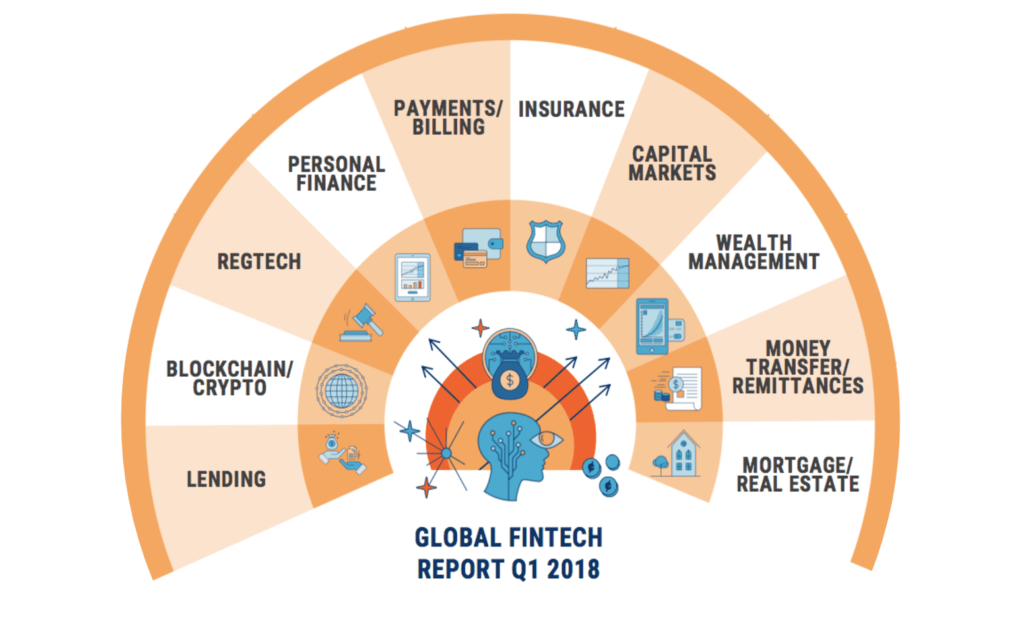
Featured Graphic Chart
The following chart from CBInsights (Global Fintech Report Q1 2018) is a data-driven look at global financial technology investment trends, top deals, active investors, and corporate activity.
Because FINTECH is becoming so popular and part of the financial services industry, there are many tantalizing career options in the field for finance students and professionals to consider.
FINTECH Jobs of the Future
Because the main drivers of FINTECH are AI and blockchain, you’ll see a number of jobs and degree options in these areas:
1. Blockchain Developer
This growth will greatly increase the need for blockchain experts, such as blockchain developers.
According to Hacknoon.com, requests for block chain programming talent are soaring. According to the freelance talent marketplace Upwork, blockchain rose to one of the fastest growing skills ouf of more than 5000, and there was a year over year increase of more than 35,000%.
Interested in becoming a blockchain developer? You should learn these programming skills:
Hyperledger Fabric: Enterprise blockchain framework that uses modularity and scalability to support changing business rules.
Ripple: Payment protocol for distributed payments, exchanges and remittances.
Solidity: Smart contract development on the network Ethereum.
2. Apps Developer
The FINTECH apps market has seen spectacular growth over the last several years. Global app downloads and consumer spending have been hitting record levels, according to recent reports. The demand for mobile payment solutions and personal finance is only growing, as it is being driven by an appetite from younger generations of tech-savvy consumers.
Millennials also are more likely to use their increased ability to make payments securely on their phones.
Visa has reported more than ⅓ of users made a peer to peer digital payment over a mobile device, and ⅗ have sent money to family with a mobile device.
There will be a stronger need in future years for financial technology app developers to serve this booming market.
3. Financial Analyst
A financial analyst is responsible for managing budgets against incoming income forecasts. Depending upon the size of the firm, you could be an analyst for a single division or the entire company. Financial analysts assemble financial reports and do forecasts of incoming revenue, as well as run business studies. See full financial analyst salary outlook.
Financial analyst jobs in FINTECH are in great demand as startups continue to grow.
These new financial services businesses need financial analysts to manage their revenue, but they also need new graduates to work with clients to analyze the data through the use of whatever startup or tool the company has built.
Demand in this field is only going to grow, as venture capital funding in FINTECH hit $13.6 billion in 2016.
4. Product Manager
Product managers are now regularly needed to handle the oversight of many FINTECH products. For example, a listing on Linkedin.com has an opening for a Senior Product Manager for a well funded blockchain startup that works in the data security space. Product management work dovetails with initiatives in cryptography, encryption, online identity and security.
The product manager will design, architect, and develop a decentralized blockchain network that allows strong data security, strong control of data, easy integration, creation of new profit centers and reduction of cost.
Skills are needed in Agile and Scrum, as well as three years of experience as a technical product manager. See full salary outlook for product manager.
5. Compliance Expert
As the regulatory burden in FINTECH grows, there will be more compliance experts, compliance officers, and compliance analysts working in these financial companies.
In fact, the major area in finance that has seen steady job growth since the financial crisis has been in compliance, legal and risk areas, Reuters says.
Online thieves and hackers always go where the money is. Financial services will always be a major target. According to research from IBM’s X-Force research team, the financial services industry has been attacked more than any industry since 2016. But the cyberskills security gap is large and growing. See 5+ best Cybersecurity degree programs.
A report by Cybersecurity Ventures recently estimated that cyber crimes will be triple the number of job openings in the next five years. There also will be at least 3.5 million unfilled cybersecurity positions by 2021.
Demand is red hot for these workers in FINTECH.
7. Quantitative Analyst
‘Quants’ are the smart people who write the big, complex financial models. They are the ones behind the data-driving trading technology that large investment banks and hedge funds use to trade securities and analyze risk. As big data continues to rise, quants are becoming more important in FINTECH to devise models that can sort through the massive amount of data and automate them so that trading can be a mostly automatic process. See 5+ best quantitative analysis degree programs.
The Wall Street Journal recently wrote that the quants now run Wall Street. There are so much in demand that their compensation packages can be as high as $500,000 per year.
These math, computing and finance experts are also sought by FINTECH companies; quantum computing is important to develop the algorithms of the future.
8. Culture Champions
Sure, this sounds like a feel good job title, but for FINTECH firms, a positive, innovative and entrepreneurial image is important to success as their employees are the best advertisement for their brand. FINTECHs must ensure all workers are happy and fulfilled.
Keeping talent is so important because hiring the most skilled candidates in the biggest expense of the FINTECH, but also is vital to future development. HR champions and culture evangelists who can build and maintain a diverse workplace will be in great demand.
9. Business Development Manager
Business development managers are very important in FINTECH organizations because they help to generate new income and help many startup companies to grow. Business development managers look for new markets, new business partnerships, and new ways to tap existing markets. See full salary outlook for business development managers.
Business development managers also:
Generate new leads and call on cold prospects to sell FINTECH services
Develop new opportunities in new target markets with marketing support
Nurture and develop business relationships with new FINTECH accounts
Provide specific advice on the FINTECH product or service you are selling
10. Data Specialist
Deloitte recently highlighted the important strategic role of data in a report with the World Economic Forum about trends affecting the financial services industry. Innovation that emerges will allow financial companies to have access to new sets of data, including social data, and allow new ways to understand markets and customers. See 5+ best data analytics degree programs.
As clients are more empowered by the Internet and digital technologies, clients are becoming more proactive and want new financial services companies to give them more individual services tailored to their needs. So, there will be a need for data scientists, chief data officers, financial data analysts and data analytics managersneeded to sift through information that can provide more insights into their markets.
Suggested FINTECH Job Skills
If you want to position yourself to be recruited for a lucrative FINTECH job, below are the most popular technology skills searched for by recruiters in the eFinancialCareers CV database:
Java: This programming language is nearly always in job descriptions for investment bankers. It is the programming language that causes headaches for recruiters because there is a shortage of talent. Banks want Java workers to work on order management systems, low latency training programs and more. JP Morgan, Goldman Sachs and UBS all want Java programmers.
Business/Finance analyst: Higher demand suggests that banks are thinking in a strategic way about implementing new IT projects. Banks are hiring process change specialists who understand how to do overhauls of back office products and also compliance reporting.
C#: The big buzz phrase is ‘building risk weighted asset tools.’ In the risk and analytics team, and possibly partnering with offshore developers C# programmers who can assist banks to devise tools to calculate RWAs are in high demand.
Murex: Most jobs that want this knowledge are less about a specialist in the language and more focused on having familiarity with it in a broader list of technical skills. Many consultancies want Murex as an important skill on their strategy teams. Quants also are wanted with this knowledge so they can integrate analytics with Murex.
Python: This is a red hot skill for developers in the financial sector. Major banks such as JP Morgan and Bank of America Merril Lynch are employing thousands of developers cranking out Python code. It is becoming a mainstream language for many software products. The trend these days is to bring in Python developers for new interest rate derivatives platforms.
Who’s Hiring: Current Open FINTECH Jobs
So who is hiring in FINTECH? The question is more like, who is NOT hiring? A brief review of open FINTECH jobs listed on Indeed.com reveal companies hiring for these positions:
Bank of America – SAS/SQL Analytics and Reporting Analyst
TradePMR – Help Desk Engineer
ETFLogic – Fintech Quantitative Developer
OppLoans – PostgreSQL DBA
Frog – Senior Strategist Financial Services
Perpay – Data Analyst
Wachsman – Strategy Analyst/Associate
Correlation One – Business Development Associate
Passport – Associate Product Manager
Acorns – Finance and Strategy Analyst
Figure – Associate Product Manager
Shogun – Associate Product Manager
Finicity – Junior Developer
Liberty Lending – Entry Level Finance
E*Trade Financial – Visual Designer
Bank of America – BP, Customer Loyalty and Engagement
Unison Home Ownership Investors – Treasury Manager
TradePMP – Help Desk Engineer
Fintch/Insurtech Space – Senior UI Architect
Coinbase – Senior Financial Analyst
CITI – Engineering Manager FINTECH
CITI – FinTech Product Manager
FINTECH is a rapidly growing space that most students and professionals will want to learn more about in the future, as so many high-paying jobs are going to be in this sector.
9 Best Blockchain Careers and Jobs to Get for 2019
2018 was a mixed year for blockchain technologies. The star of the show, cryptocurrency, saw a huge decline in value, with crypto’s total market capitalization shedding more than three-quarters of its value over the course of the year. Add to that uncertainty over legal and regulatory hurdles to blockchain adoption, and you could be forgiven for thinking 2018 was a bad year for the technology.
If it was supposed to be a bad year, someone forgot to tell
blockchain hiring managers and recruiters, as hiring sites saw huge
surges in openings for blockchain- and crypto-related jobs. Glassdoor saw a 300 percent jump between August 2017 and August 2018.
So for those eager to start or advance a career in blockchain, you
don’t need to worry that the moment has passed you by. Whether you’re an
engineer, designer or developer or you fill a business-related role,
there’s no doubt you should consider a career in blockchain in 2019 if
the promise of this emerging technology is something you find exciting.
Blockchain Industry at a Glance
2018 was tough for cryptocurrencies’ value, but a look at the broader
data reveals a more complex story. Let’s take a closer look:
Total value
79% decline in market cap in 2018
The story is even worse when you take Bitcoin out of the mix, as non-Bitcoin cryptocurrencies shed almost 90 of their total value.
Barriers to adoption
What’s keeping companies from using blockchain technologies? According to a PwC Global survey, the top concerns are:
Regulatory uncertainty: 48%
Low trust among users: 45%
Inability to bring network together: 44%
A big bright spot
Despite those concerns, companies are still investing in blockchain, which leads to more jobs.
300%
Increase in blockchain job listings on Glassdoor between August 2017 and August 2018
$84,884
Median blockchain salary, far higher than the national median wage for all jobs
Despite a bumpy 2018, 2019 looks to be a banner year for jobs in
blockchain, and here are nine of the best jobs to consider, which
companies and industries are hiring and what salary levels you could
expect to see when you hit the job market.
Blockchain Technologies You’ll Need to Know
While each job and company are unique, several technologies and skill
sets are common across all hands-on technology roles at blockchain
companies, and even if you’re not typing code all day, it’s helpful to
understand the basics of the underlying technology. Here’s a look at
some of what you’ll likely need to know:
Tools & languages
C++
C#
Java
JavaScript/JavaScript ES6
JSON
Python
Simplicity
Solidity
Serpent
Ruby
GO
Rust
js
HyperLedger Fabric
SQL
NoSQL
Broad skills & traits
Creative thinking: As a constantly
evolving technology, the way you apply blockchain on your first day at
work likely will change over time, so you need to be creative enough to
imagine how the code you’re working on might be used 10 years from now.
Passion: Ask the average person to explain
blockchain and chances are you’ll get blank stares, but if you’re going
to work in blockchain, even in non-technical roles, you need to love the
underlying technology and know how to translate it for a general
audience.
Humility: Remember you’re working on an emerging
technology in a company or department that’s potentially unstable. If
you approach your job as if you’re the king of everything, you could be
in for a rude awakening if regulations or laws change.
Top 9 Blockchain Careers & Jobs for 2019
As we already mentioned, just because you’re not a hot-shot engineer
or developer doesn’t mean you can’t get in on the blockchain job boom,
as some of these jobs prove.
1. Software Engineer
Any company investing in blockchain needs software engineers, making
this job by far the most in-demand among all companies hiring. Specific
duties will vary according to the industry and how developed the
company’s existing technology is, but experience in ledger technologies
like Solidity and HyperLedger Fabric, as well as database, programming,
cloud and other languages will be required.
Most companies are seeking individuals with at least undergraduate
degrees in computer science, computer engineering or other engineering
degrees, especially for high-paying senior roles.
Popular industries include currencies, of course, but also smart contracts, regulatory technology, banking and others.
Salary range
$90,000-$145,000
Who’s hiring
Chronicled (San Francisco), Axuall (Cleveland), Blockstack (New York)
2. Technology Architect
A role that requires technical expertise but also a strong dose of
the human touch, blockchain technology architects are responsible for
end-to-end implementation of blockchain solutions. Technology architects
participate in broad discussions on what and how technologies will be
implemented and often serve as the company’s representative to
customers.
Knowledge of and experience in the programming languages needed to
produce blockchain applications are needed, and computer science degrees
are generally required for senior roles.
Popular industries include cloud and web services, cryptocurrency and business services.
Salary range
$100,000-$160,000
Who’s hiring
Amazon/AWS (Seattle and Los Angeles), Bank of America (Charlotte, North Carolina), State of Colorado (Denver)
3. Product Manager
These individuals lead all aspects of design and development of
blockchain applications across multiple teams, ensuring products are
delivered on time and in budget. Hands-on programming experience is
generally not required, but knowledge of languages and programs used is
helpful. Experience with project timelines and budgets isrequired.
Required education varies widely depending on the specific products
developed at each company, but generally, successful candidates will
have at least bachelor’s degrees a technology- or management-related
field.
Industries include advertising and media, cryptocurrency and banking.
Salary range
$85,000-$130,000
Who’s hiring
Mediaocean (New York), JP Morgan Chase (New York), Cynet Corp. (Springdale, Arkansas)
4. Risk Analyst
Ensuring compliance with local, state and federal regulations, a
blockchain risk analyst’s daily job will vary depending on the industry
and how developed their employer’s technology is, but they could be
aiding in programming and development, conducting data analysis or
maintaining documentation on products and technologies.
The required education will depend entirely on the specifics of the
job, but risk analysts interested in careers in blockchain should have a
strong grasp on the technology and specific programming languages used
to build blockchain applications.
Most risk analyst jobs in blockchain will be in finance- and government-related industries.
Salary range
$85,000-$105,000
Who’s hiring
Veem (Ottawa), Bank of America (Jacksonville, Florida), Electric Power Research Institute (Knoxville, Tennessee)
Analyst Relations Manager
Primarily a media communications role, an analyst relations manager
at a blockchain company helps position the company and its technology
the company’s broad industry and the market at large. This person is
responsible for ensuring that analysts within the industry are aware of
their employer’s technology and consider it a viable and positive option
for their own companies or clients.
Successful candidates will have experience and education in media,
communications, PR or journalism as well as a deep understanding of
blockchain, related technologies and issues within the industry.
Industries hiring analyst relations managers are ones where good PR
is necessary for continued adoption of technology, such as government,
banking and consumer technology.
Salary range
$50,000-$125,000
Who’s hiring
IBM (New York), Accenture (Atlanta, Chicago, Washington, D.C.), R3 (San Francisco)
Front End Engineer
As the person who creates whatever it is the end user sees, a front
end engineer puts the best possible face (and functionality) on a
blockchain company’s customer platform. Programming experience is
mandatory, and interface/UX/UI skills are a must. Specific programming
languages will vary depending on the employer and its platform, but
generally, blockchain front end engineers will need to be masters of
ledger technologies and programming languages like JavaScript, Angular
and Redux as well as HTML and CSS.
Educational requirements vary, but generally, degrees in computer
science are helpful, though self-taught computer scientists with work
experience in web and computer design and programming will be strong
candidates.
Popular industries include currencies, lending and banking and healthcare.
Salary range
$70,000-$125,000
Who’s hiring
Gem (Los Angeles), Binance (Austin, Texas), Ford Motor Co. (Dearborn, Michigan)
Legal Counsel
In an industry filled with legal and regulatory confusion, privacy
issues and consumer protection statutes, as well as potential conflicts
over intellectual property used to develop code and algorithms, lawyers
are in huge demand in the blockchain industry. Blockchain lawyers don’t
need to be programming experts, but they need to have or develop a deep
understanding of the underlying technology and development processes so
they can better protect their employers from legal trouble. Experience
in mergers and finance law is helpful, too, as blockchain businesses are
often targets for purchases by larger companies.
Successful candidates will need a law degree and license to practice,
and most companies will heavily weight applicants with blockchain
experience or years working for startups.
As regulatory and consumer privacy issues are central to any
blockchain company, you likely can find employment in any field within
blockchain.
Salary range
$100,000-$190,000
Who’s hiring
Consensys (New York), BitGo (Palo Alto, California), Figure (San Francisco)
Business Analyst
Using data science and business analytics tools, business analysts in
blockchain measure effectiveness and efficiency of deployed products
and recommend updates and improvements. These individuals also monitor
and examine market trends to recommend the best positioning of the
company and potential new products. Deep knowledge of data analysis
tools and programming languages, such as Python, is necessary.
Particularly for senior roles, degrees in data or computer science
will be needed, and experience with programming languages related to
blockchain is helpful.
Most openings for business analysts in blockchain are likely to be in consumer-facing products, as those markets shift quickly.
Salary range
$80,000-$105,000
Who’s hiring
IBM (Research Triangle Park, North Carolina), NuArca (Wodburn, Massachusetts), Bittrex (Washington, D.C.)
Cryptocurrency Community Manager
A key part of marketing and customer support, blockchain community
managers maintain and develop their employers’ presence on social media,
forums and other internet outlets as well as developing content
appropriate to answer customers’ frequent questions. They also are
responsible for reporting engagement statistics across all
channels.While they won’t be in charge of programming their employers’
blockchain applications, they need a well of understanding about the
product and underlying technology.
A marketing or PR degree likely won’t be necessary, but successful
applicants won’t be entry-level individuals, as blockchain companies,
which are likely to be startups, don’t have deep benches for these
roles, so you’ll need to hit the ground running.
Consumer-facing industries, like banking, frequently hire in these roles, as do blockchain recruitment agencies.
Salary range
$35,000-$95,000
Who’s hiring
Dolare (South Bend, Indiana), Zeus Protocol (San Francisco), Crowdcreate (Los Angeles)
* Information on job openings, responsibilities, salaries and companies gathered from Indeed and Glassdoor in early January 2019
Conclusion
Despite a rocky 2018 in cryptocurrencies, the blockchain is alive and well, judging by investment in human capital.
Whether your skill set is in cracking out code or putting the
company’s best foot forward, if you have a passion for blockchain and
cryptocurrencies, there’s likely a company hiring near you now, and that
trend is likely to continue through 2019.
The following article provides information about the most important aspects of a finance career. You will learn what finance professionals do, where they are employed, job duties, how to become one, popular career choices, and more.
What We Do
Over the last several decades, the financial services sector of the
economy has increased from 2.5% to 8.5% of national GDP. Today,
financial professionals or financial managers are responsible for
handling the financial health of organizations and individuals. Finance
professionals focus largely on the production of financial reports,
directing critical investment activities and devising effective,
innovative strategies to enhance the long term financial health of an
organization.
The role of the financial professional in the modern business world
is evolving as advances in technology have greatly reduced the time that
is required to generate financial data reports. Many financial
professionals today in management are now doing more rigorous financial
data analysis, as they offer senior level managers more specialized
advice on how to increase profits and reduce waste.
Job Duties
Most finance professionals do some or all of the following:
Prepare complex financial documents, personal financial statements, business activity statements, and financial forecasts
Monitor critical financial details to make sure that all legal and regulatory requirements are followed
Oversee employees who are responsible for financial budgeting and reporting
Review financial reports for companies and look for ways to cut costs
Perform market trend analyses to increase profits and to look for ways businesses can expand
Assist management and individuals to make important financial investment decisions
There are many types of finance managers today; the type that you
will be often depends upon your career goals and the size and scope of
the organization.
Common types of financial managers include chief financial officers,
controllers, credit managers, cash managers, risk managers, treasurers,
and insurance managers.
Where We Work
Financial professionals can work in many types of business
environments. For financial managers, we most commonly work in these
areas below:
Finance and insurance companies: 29%
Management of companies and enterprises: 12%
Professional and technical services: 11%
Manufacturing: 8%
Government: 8%
Financial professionals will not always be working just in New York,
Chicago and Los Angeles today, either. According to Forbes magazine,
there are many cities across America today that are adding more
financial sector jobs than some of the biggest US cities.
While New York City will always be a major finance capital of the
globe, other cities with a lower cost of living and higher economic
growth are attracting more finance and finance related firms. In fact,
since 2007, financial sector employment in New York City actually
declined by at least 5%.
Some of the top cities in America seeing rapid growth in finance jobs are:
Richmond, Virginia
Pittsburgh, Pennsylvania
Fort Worth, Texas
San Antonio, Texas
Jacksonville, Florida
Dallas, Texas
Northern Virginia
Louis, Missouri
How to Become
To work in the finance sector, you will need to have at least a
bachelor’s degree in finance or business. To become a finance or
financial manager, you will need to have several years of business
experience in a financial, business or accounting related field.
To enjoy more opportunities in finance, it is recommended that you
get your MBA in finance or accounting. Or, you can earn a Master of
Science in Finance or Accounting.
Employment in the financial sector generally is going to increase by
8% by 2024, which is about as fast as average when weighed against other
fields. In total, the finance field will add approximately 632,000 new
jobs in the time period.
It seems that a more robust regulatory environment is driving demand
for more finance professionals, accountants and auditors. Also, the
economy is generally growing faster in the US. This is causing a
business expansion which leads to more companies starting, and the
growth of existing companies. These trends lead to more finance
professionals being hired.
The median wage for all finance professionals in 2015 was $65,710.
Finance professionals in some areas will earn a higher salary,
especially if they have a graduate education.
Career Paths
There are many different career paths for professionals who want a
finance career. Consider these popular finance career options:
Financial analyst:
You will offer financial and business advice to companies that must
make vital investment decisions. Financial analysts need to properly
assess the overall performance of bonds, stocks and many other
investments. A financial analyst can work either as a sell side or a buy
side analyst. Sell side analysts provide advice to financial sales
staff, while buy side analysts provides investment strategies for
companies that need to invest.
Financial examiner:
Ensure full regulatory and legal compliance involving financial
institutions and any financial transactions that occur. You will handle
the review of balance sheets, evaluate loan risk and assess how
effectively banks are managing their assets. These finance professionals
usually work in risk scoping or in consumer compliance.
Financial manager:
They answer for the overall financial health of a company. The are
largely active in managing the production of financial reports,
providing effective investment advice, and forming new strategies to
enhance the financial health of a company. Financial managers must do
specific tasks that are in their given industry or organization.
Government financial managers need to be highly skilled in budgeting and
government appropriations, for example.
Personal financial advisor:
Offer advice to individuals on investments, mortgages, insurance,
college savings plans, planning on retirement, and overall help in
managing finances. You will need to be current and knowledgeable on
stocks, bonds and real estate investments, and also insurance and tax
laws.
Education Requirements
Most finance professionals earn a bachelor’s degree in business,
finance or accounting. It is strongly advised to have courses in
finance, mathematics, investments, estate planning and risk management.
To work at a mid or senior level finance position, you should plan to
earn your master’s degree in finance or accounting. Or, you can earn
your master of business administration with a concentration in finance
or accounting. Earning an MBA will provide you with a more rounded
business management education. This may be beneficial if you want to
work more generally in business management with a good knowledge of
finance.
But if you want to work exclusively in finance, a master’s in finance would probably be ideal.
Specializations
There are several types of finance that you should understand so that
you can make the best career choice. The major areas of the business
finance field are listed below. Which type of finance professional you
want to be hinges upon in which of these areas you want to work the
most:
Corporate finance: Refers to the actions that a company undertakes
when it makes finance decisions. Specific areas of corporate finance
where you can work are budgeting, managing capital, financial analysis,
and development of financial statements.
Investments: Companies and individuals invest in various financial investments, and need financial professionals to advise them.
Financial institutions and markets: Stock and bond markets, money
and capital markets, as well as the primary and secondary markets.
Training and Certifications
There are many certifications that you can earn in the field of
finance. Which you may want to earn depends upon the area of finance in
which you work:
Chartered Financial Analyst or CFA: This is one of
the most popular certifications in finance; you will have expertise in
investment banking and analysis, economics, management of portfolios,
and financial ethics. A good choice for financial analysts, bank
managers, financial consultants.
Financial Risk Manager or FRM: Risk management
today is critical in finance as the US government is watching much more
closely that finance and lending companies are engaging in ethical and
smart business practices. A great choice for financial advisors,
financial analysts, credit managers, and fund managers.
Certified Financial Planner or CFP: A highly
popular choice for financial advisors and planners. Provides you with
expertise in retirement, estate and insurance planning. This
certification mandates that you have a bachelor’s degree, complete three
years of related work experience, pass a certification examination, and
you must also adhere to a strict code of ethics. Covers financial
planning processes, risk management, taxes and retirement, and debt
management.
Financial Modeling Certification: Useful for a
financial professional to be able to expertly construct effective models
to represent financial accounts and investment analyses. Financial
modeling is very useful to deliver accurate investment and business
forecasts for companies. Excellent certification for investment bankers,
financial managers and financial advisors.
Certified Credit Professional or CCP: Granted by
the Credit Institute of Canada that ensure that credit management
professionals have exemplary levels of training. Very important
credential for any finance professional who is working in credit
management.
Kotkin, J. The Cities That Are Stealing Finance Jobs from Wall
Street. (2013, May 31). Retrieved from
https://www.forbes.com/sites/joelkotkin/2013/05/31/the-cities-taking-finance-jobs-from-wall-street/#4244d8145297
Millennials, those born between 1981 and 1996, are changing the US housing market. Millennials are mobile and tech-savvy, and have strong opinions on the types of houses they are looking for and at what price. It is a wise mortgage professional who learns this growing, important market segment. Learn more about how the housing market is changing with the growth of the millennial buying population in the article below.
Millennial Home Buyers – The Dominant Home Buying Demographic Today
Many mortgage brokers and real estate agents are unaware of just how large the millennial home buying market is today. It is estimated that millennials are now the largest group of home buyers, making up at least 34% of the market. And, they are 66% of first time home buyers. (Nationwidemortgages.net).
Millennials have become the overarching force in the US housing market. In 2016, Millennials associated owning a home with the American dream far more than other age groups:
18-34: 65%
35-49: 58.4%
50-64: 56.9%
65+: 63.9%
According to 2016 data, most millennials expected to purchase a home within three to five years:
Next year: 9.2%
One or two years: 23.7%
Three to five years: 33.2%
Unsure: 7.6%
Never: 1.8%
More than five years: 24.4%
Millennials Proving to Be Tech Savvy Home Buying Researchers
Almost every millennial – 99% by some estimations – looked online when searching for a home. That compares to older baby boomers from 62-70 at 89%, and the silent generation at 77%. In all, 95% of American home buyers used the Internet to look for a home.
Also, millennials like to search for their dream home on mobile devices; 58% of this key age group used their smartphones to find a house, while Gen-Xers used smartphones 46% of the time, and younger boomers from 52 to 61 used them only 33% of the time.
Statistics further show that 76% of millennials did a driveby of a home because of an online advertisement they saw, and 64% of millennial potential buyers did a home walkthrough after they saw a listing online.
These young, savvy buyers used technology in January 2019, reports from Ellie Mae suggest, to refinance their home loans when rates dropped that month. Millennial refinances were at their highest rate since February 2018, and accounted for a whopping 13% of all closed loans. (MPAmag.com).
Millennials Trust Realtors
One of the most interesting findings of recent millennial home buyer surveys is now much they trust realtors to help them find their dream home:
Millennials: 92%
Gen-Xers: 88%
Younger baby boomers: 87%
Older baby boomers: 85%
Silent generation: 86%
They Want Homes Ready to Move Into!
Older Americans often do not mind buying a ‘fixer upper’ that needs some TLC before becoming their dream home. This does not describe the millennial home buyer. Most do not want to spend the money or time rehabbing an older, distressed property. They tend to purchase newly built homes to avoid issues with renovations, as well as electricity and plumbing problems. Surveys show 48% of millennials want to buy a new home, while only 34% of all buyers want the same.
Student Debt and High House Prices Are Major Obstacles
While the median household income for millennials is a healthy $82,000, they also are saddled with student loan debt.
According to Forbes, there is $1.56 trillion in student loan debt in the US. This has a major effect on the ability of millennials to buy their first home. Bankrate.com reports 31% of Americans to have student loan debt that is from their own education. Also, 13% of American adults have financed another family member’s school costs via student loans. Of people who responded to the Bankrate.com survey, 31% said they were delaying buying a home because of student loan debt.
Approximately 46% of millennials owe at least $25,000 in student loan debt, which is a monthly payment in many cases of $200 or $300. Millennials also say saving for that down payment as a first time home buyer with no equity in a current property is the biggest challenge.
Another major challenge for the millennial home buyer is that for those who are settling in major cities such as New York, Washington DC, Los Angeles, San Francisco or Boston, there is a high chance they are being priced out of these desirable but very expensive markets.
That said, some mortgage managers say that mortgage companies that provide better low money down mortgage programs could help millennials to become homeowners, and increase their market share in this incredibly important age demographic. There now are programs out there where you can put down less than 3% down.
Regarding student loan debt, there are conversations in Washington DC about how to put millennials in a better buying position. There are discussions about having only one government income based-repayment plan. Today there are five potential loan forgiveness programs of the remaining loan balance after 120 payments have been made. If you can see your student debt end by age 32, some finance experts say, you could see a scenario where you can possibly buy your first home faster.
Some Millennials Setting Off for Lower Cost Markets
While many younger home buyers are struggling with home affordability and student loans, a March 2019 report by CoreLogic shows that more millennials are heading off the beaten path of higher-priced markets on the coasts and going to Pittsburgh, Buffalo, Provo and Rochester, New York to find lower-priced homes. In these and other smaller metro areas in the middle of the country, buyers can get more house for their dollar. And because prices are lower and mortgages smaller, qualifying is easier. (Homebuyinginstitute.com).
CoreLogic analysis finds millennials make up a higher percentage of home buyers in smaller housing markets in the Midwest. On the other hand, there is a lower number of them in the country’s expensive coastal markets. This makes sense, as most millennials are buying for the first time and do not have equity from a previous sale to buy their new home.
CoreLogic analysis found the following markets had the highest share of millennial buyers. Realtors and mortgage brokers in these cities – pay close attention!
Pittsburgh: 57%
Provo: 56%
Rochester: 55%
Buffalo: 55%
Des Moines: 54%
Data also showed that millennials are getting mortgages in states that border high priced markets. For example, millennial mortgage applicants from New York most often apply for mortgages in Pennsylvania and New Jersey. And applicants in California apply for mortgages in Nevada and Texas.
There is another reason that these smaller real estate markets are gaining cache with the millennial buyer: These markets are showing strong price growth in 2018 and 2019. For instance, the median home value in Pittsburgh rose by 10% over the last year, per Zillow data. That is well above the 7.2% rise across the country in the same 12 month period.
In Provo, the median home value spiked 17% over the last year. That is double the national average. It is expected the Provo real estate market will outpace the US overall through 2020, too. (homebuyinginstitute.com)
While Buffalo may not seem to be a ‘hot’ market, for millennials, you would be surprised. Prices in this upstate New York industrial city rose by double digits from 2018 to 2019. Millennial buyers looking for value will find them in Buffalo. Utica is another hot place for people in their 20s to buy a home, according to a new Realtor.com list. A major attractor for this upstate New York town is the low prices for homes; the median list price here is just $130,000, while nearby Albany has a median list price of $300,000. (uticaod.com).
Port St. Lucie in Florida is yet another affordable market that is attracting many millennial buyers. It is ranked in the top 10 nationwide for cities with the highest levels of millennial homeownership, according to SmartAsset. Fifty-three percent of these buyers in town own their homes. With average home prices a mere $175,000, Port St. Lucie is a good value for the young homebuyer. (wptv.com).
Millennials Plan Short Stay in First Home
Of all age demographics, millennials are the least likely to define homeownership as permanent. Many of them expect to eventually move and upgrade to a bigger and better home:
Millennials: 11%
Gen-Xers: 23%
Baby Boomers: 29%
Seniors: 37%
Also, 68% of millennials view their current home as a stepping stone to a better one they want in the future, compared to 36% of all buyers. Millennials keep their homes only an average of six years before selling, while all buyers keep their homes an average of 10 years before posting the For Sale sign.
What Home Features Millennials Like Best
When it comes to the features in their new digs, millennials have specific tastes, surveys suggest:
Large kitchen with an open floor design: The kitchen is where people hang out in the home, and millennials say it should flow easily into other rooms for entertaining.
46% of these young buyers also say they want a ‘luxury kitchen.’
Energy efficiency is also important to them; millennials say they are willing to do green upgrades on their homes out of their own pockets. Nearly 50% want solar panels and ways to efficiently store energy from the panels.
When it comes to appliances, 75% of young buyers want new, gleaming appliances already installed when they shop for a new home.
Many millennials are working from home, so they want to have a large, designated home office to handle their telecommuting.
Of course, new technology is tops on the list for the millennial home buyer. Good cell reception and many Internet provider options can be make or break issues for millennials.
Close to home: Millennials have seen their parents do brutal commutes. Most want no part of it and 65% want a home close to their job.
Summary
Data shows millennial home buyers are looking for newer homes with all the amenities, but also are sensitive to price due to not having a previous property to rely on for a down payment. Mortgage professionals who want to target the coveted millennial market would do well to focus on low down payment options offered via social media and other online advertising options. Target markets should be the hot, affordable ones in the interior US, where prices and mortgage amounts are reasonable for young people with student loan payments looming for a decade or more.
References
Utica Lands on Realtor.com List of Top Cities for Millennial Homebuyers. (2019). Retrieved from
SEO stands for search engine optimization. SEO copywriting is essential for those who want to be highly ranked in major search engines for certain keyword phrases. What effective SEO copywriting does is:
Locate keywords that you want your company to rank for
Write detail-rich, unique content about the subject containing those keywords
Over time, rank at the top of major search results for that keyword or keyword phrase



![Incidence of breast cancer in US hospital discharge data from 1998 to 2010 normalized to counts per 1,000,000 population each year, after subtraction of an exponential model accounting for the decline in the years up to 2006 in the Caucasian subpopulation [see text]. This includes all reports of ICD-9 codes 174 and 175. The red line shows trends in glyphosate usage on corn and soy crops over the same time period.](https://www.researchgate.net/profile/Anthony_Samsel/publication/283490944/figure/fig3/AS:292152778215425@1446666058102/Incidence-of-breast-cancer-in-US-hospital-discharge-data-from-1998-to-2010-normalized-to.png)